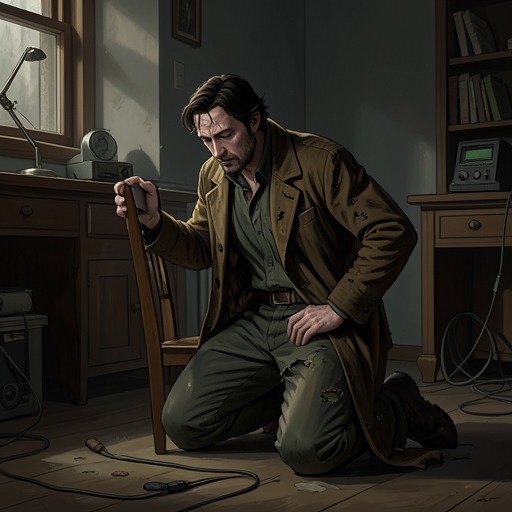
Ivan’s hallucinated encounter with the devil
The Brothers KaramazovIvan’s hallucinated encounter with the devil becomes a struggle over where Ivan’s own thoughts end and the visitor’s voice begins. After Alyosha arrives, Ivan insists that the devil had been sitting on the sofa and that the encounter was not a dream. The apparition gives bodily form to what Ivan finds mean and contemptible in himself, yet its taunts also force him to hear truths he had not been willing to admit. The scene ends not with certainty about the visitor’s independent reality, but with Ivan’s physical and mental collapse as Alyosha keeps watch.
The Visit and Ivan’s Insistence
Ivan rejects the idea that the encounter was merely a dream. He says the visitor had been sitting on the sofa and recalls that, when someone knocked at the window, he threw a glass at him. His account gives the hallucination a sharply defined place in the room and an object tied to his response, even as his insistence that it was not a dream leaves the status of the experience unsettled.
Ivan tells Alyosha that the devil has visited him twice, almost three times. The visitor is not, he insists, the grand supernatural figure Ivan associates with Satan, scorched wings, thunder, and lightning; instead, he is a simple devil who taunts Ivan for being angry at the modesty of the apparition. The comic scale of this visitor does not lessen his power over Ivan. His smallness itself becomes part of the provocation, and Ivan’s explanation shows how the encounter has repeatedly returned rather than passing as a single, isolated dream.
The Devil as Ivan’s Double
Ivan calls the devil himself: the mean and contemptible element within him. He also recognizes the visitor’s cleverness as a means of provoking him. The devil’s taunts about Ivan believing in him keep Ivan listening, making the apparition’s power depend not only on supernatural menace but on Ivan’s own reaction to the possibility that it is real.
The visitor is not simply a voice Ivan can dismiss. Ivan admits that it told him much that was true about himself—things he says he would never have confessed to himself otherwise. That admission makes the encounter a disturbing form of self-recognition: what Ivan experiences as an adversary can articulate knowledge that belongs to Ivan, while appearing to come from outside him. He even says that he would be glad to believe the devil, rather than himself, was responsible for what the visitor represents.
Alyosha as Witness and Counterpresence
Ivan’s account is directed to Alyosha, whose presence alters the scene. Ivan says that Alyosha would have driven the visitor away and adds that the devil disappeared when Alyosha arrived. He tells his brother that he loves his face, and speaks as though Alyosha’s arrival has interrupted the visitor’s hold over him. The affection is strikingly direct: in the middle of describing an apparition that embodies his own degradation, Ivan turns toward the brother whose presence offers relief.
Alyosha answers not by confirming that the devil was physically present but by recognizing Ivan’s exhaustion. His compassionate observation that the visitor has worn Ivan out does not settle whether the encounter was dream or waking reality; it attends instead to its visible consequence. Ivan continues to describe the visitor’s teasing and its effect on him, while Alyosha remains beside him rather than leaving to summon a doctor, afraid to leave his brother alone.
Collapse and Narrative Significance
The episode moves from Ivan’s forceful insistence on the reality of the visitor to the failure of his own speech and consciousness. He continues talking after he has lost consciousness, but his words become incoherent and difficult to articulate; he then staggers violently, with Alyosha there to support him. The devil encounter is thus embedded in the immediate progression of Ivan’s illness, not presented as an episode that can be cleanly separated from his physical deterioration.
The scene’s unresolved boundary between hallucination and waking experience is central to its effect. Ivan supplies concrete details—the sofa, the window, the thrown glass—yet the visitor’s most consequential disclosures are inward: he voices truths Ivan recognizes as his own and gives his self-accusation the shape of another speaker. Alyosha’s arrival interrupts the visit but does not dissolve the conflict. Instead, the encounter leaves Ivan exposed, exhausted, and dependent on his brother’s presence as his consciousness gives way.